

Just a quick update on the flax retting we have been doing.
We had a couple of problems with the sunny weather and a constant breeze drying out our retting pond. In future we will dig retting ponds in sheltered, shaded location (part of the fun of experimenting is learning these little, but very important things!).
The flax retted well and is now standing upright, under shelter, drying out. Once its dried out we will bash the fibres free from the pith and have linen fibre ready for spinning.
I will post more photo's when we do this!
We were also very impressed by the 'dew' retting process (the flax was just lain flat on grass). It took a bit longer, but the fibres seem to be of equal quality. We have kept the two bundles separate and process them separately too and report on any variation.
Ancient Arts Blog

 Posts
All Comments
Wednesday, 2 October 2013

Ancient Arts new 3D Sensory Interpretation Panels - feel the past!
Looking to add quality and improve the visitor
experience to your heritage site?

Take a look at our beautiful, bronze 3D Sensory Interpretation boards: http://www.ancient-arts.org/sensory%20panelsweb.pdf What every well presented heritage site will be wearing next year!
 Made from bronze, we can make, accurate replicas of artefacts found on or associated with heritage sites. They emerge from the bronze base to be felt, but are solid metal; virtually vandal proof.
 Organic material, such as this replica sling shot can be represented as can vegetation.
 For more details visit: Ancient Arts 3D Sensory Panels

Take a look at our beautiful, bronze 3D Sensory Interpretation boards: http://www.ancient-arts.org/sensory%20panelsweb.pdf What every well presented heritage site will be wearing next year!


Tuesday, 17 September 2013
Ancient Arts at the 8th Experimental Archaeology Conference 2014, nearly as good as The Rolling Stones at Glasto!
Yea!
We will presenting a paper on our work identifying and reconstructing
the earliest known Bronze Age copper smelting furnace found in the UK at
the 8th Experiemental Archaeology Conference at Oxford Uni next January
- should be fun! http://experimentalarchaeology.org.uk/
 |
| Dave firing up the reconstructed Pentrwyn furnace. |
For more on this fascinating project go here: http://www.ancient-arts.org/pentrwyn%20exp%20report.pdf
Thursday, 5 September 2013
Bede's World Anglo-Saxon flags
Yea! We've nearly finished the Anglo-Saxon flags for Bede's World.
 |
| One of the stencils used. |
 | |
| One of the finished flags |
 | |
| A big AA thank you to Emma for all her hard work on the flags! |
Thursday, 8 August 2013
The ideal AA experiment: It's stinky and muddy! Retting flax.

 |
| Our weaving and dyeing friend, Eryl, has been growing flax this year and yesterday we started processing the plant to make linen. She has cultivated c10m square of flax this Summer. Here are the plants. The have been pulled up (root included) not cut and dried for 2 weeks. |
 |
| The seed heads and my foot. |
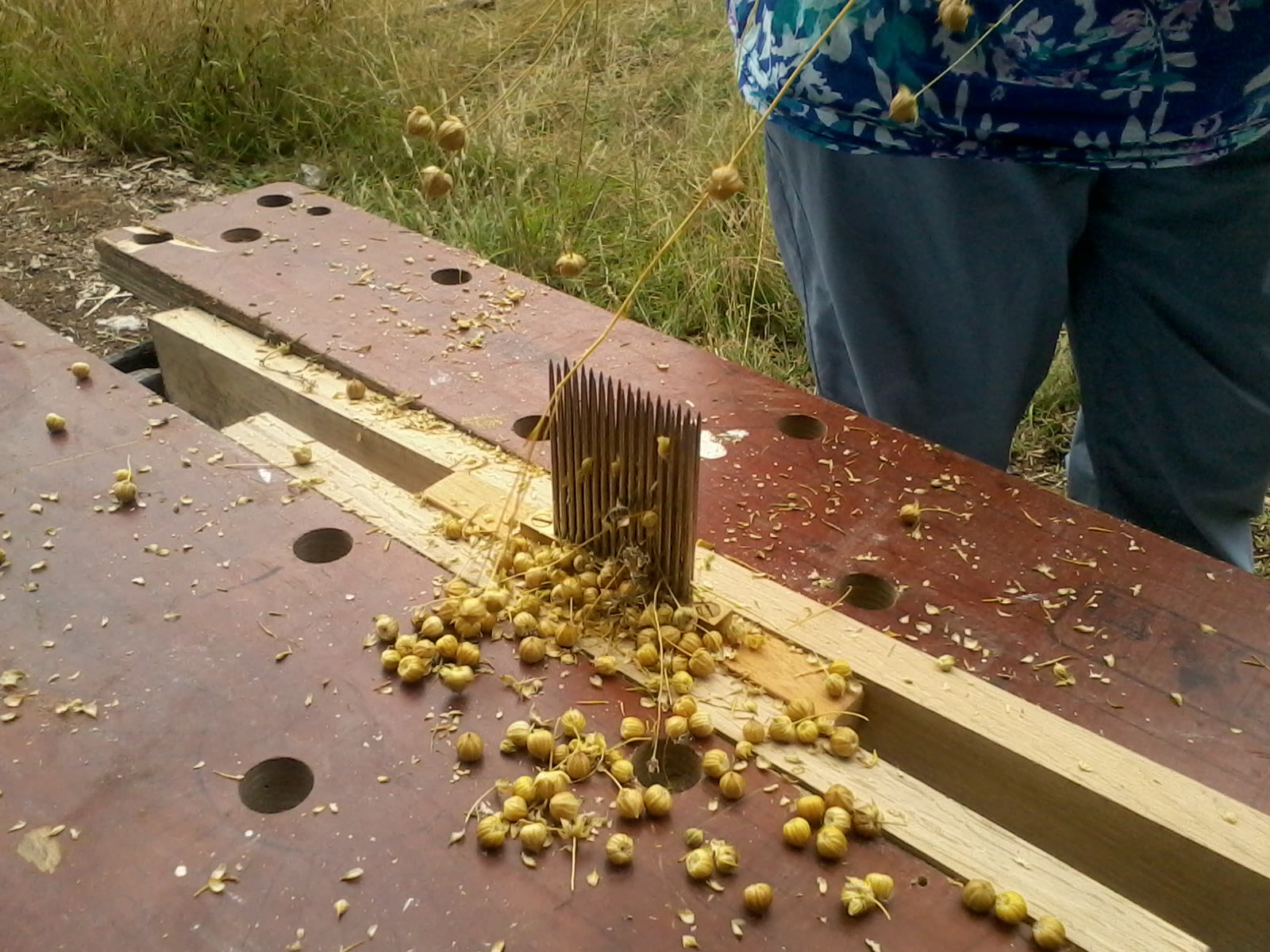 |
This is the 'hackle' or 'heckle' a comb like tool which removed the seed heads from the stalks. |
 |
This being the Summer holidays I had my little helper, Ginny, with me. She kindly agreed to help in the 'hackling'. |
 |
You draw the stalks through the 'hackle' and the seedheads fall off. |
 |
The seed heads are then collected together in a bag (old pillowcase) and either crushed between the fingers or... |
 |
bashed (Ginny's preferred technique!). This releases the seeds which can be kept for next year. Winnowing would separate the shells from the seeds, but there was no wind yesterday so we have keep them for a windy day. |
 |
Next you need an easily bribed person with a scythe (a sausage bap worked on Dave!). |
 |
I have been really impressed by the scythe. It clears overgrown areas much quicker than a strimmer and more neatly. Dave is clearing the ground ready for our retting pit. |
 |
To extract the fibres from the plant you traditionally rett the stalks. Basically leave the stalks in wet or damp conditions and let the bacteria break down the stalk leaving a foul smell and fibres. We de-turfed and dug a small pit. |
 |
To make the pit so that it holds water, we puddled it. Simply pour water into the pit and stomp up and down on it. This compresses the soil. |
 |
Continue to pour water into the pit and stomp. This makes lovely mud and saturates the surrounding soil. |
 |
Don't forget to compress the sides as well. |
 |
You know when its ready when the water starts to fill the pit. |
 |
In goes the flax! Now you just wait for a couple of weeks, check the water is still there and let the bugs do their bit. |
 |
We are also trying dew retting. Simply leaving the stalks on grass and let the dew moisten the stalks. This will take longer to break down the stalks. We also laid out some nettles on the grass to see how they break down. I will post the results. Eryl is doing a dyeing with natural dye workshop at the allotments behind the hospital in Llandudno on Sunday PM. Pop along if you can its fascinating! |
Prehistoric Life & Ancient Technologies Course: Day 2
 |
Day two started with making darts and spear throwers. |
 |
Once the darts had been straightened, flighted and the spear throwers made the target was set up (note the rogue sheep behind the target which had 3 acres to wander about in but decided the grass behind the target was the most delicious!). |
 |
David demonstrating how to use the spear thrower (located at the flighted end of the spear) as a simple lever. |
 |
Tim and Patricia ready for action! |
 |
Patricia making some adjustments to her spear. |
 |
Tim aiming for the sheep! |


 |
After spear throwing in the rain we headed indoors to make some fire to dry us off and Prehistoric lamps to take us into night! More photo's to follow. Thanks to everyone who joined us over the weekend and keep up the spear throwing practice; we will get that sheep one day! |
Prehistoric Life & Ancient Technologies Course: Day 1
We had a lovely weekend running the
Prehistoric Life course; met lots of really interesting new friends and
had a moving target (a rogue sheep!) to aim at for the spear throwing
(we didn't get anywhere near, she was too quick)!
 | ||
| Prehistoric Life & Ancient Technologies Course August 2013 |
 |
| The first day started with a stone (Graig Llwyd granite) knapping workshop and then we moved outside to construct composite tools using granite flakes/blades, natural glue and wooden handles. |
 |
| The glue was made from bees wax and tree resin (applied when heated). |
 |
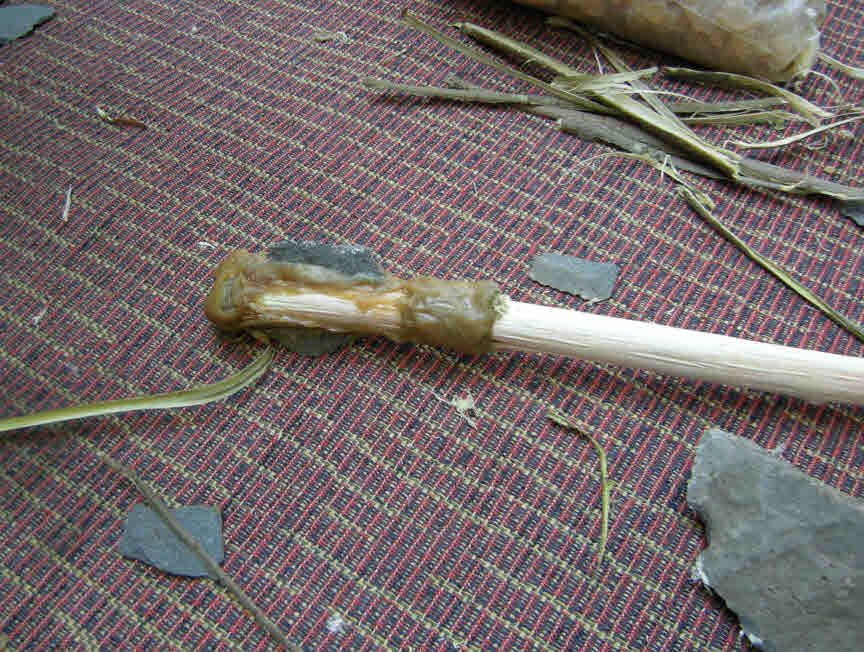 |
A finished composite tool. |
 |
We also had a go at using flint blades to cut out bone and antler 'blanks' for pins. |
 |
Then it was time to make probably one of the most important technological development by humans - string and cordage. We experimented with different plant fibres notably willow bark and nettle. |
 | |
Julie's collection of stone tools, composite tools and cordage - ready to survive the Stone Age! |
Subscribe to:
Posts (Atom)